Calcium silicate board is a rigid, non-asbestos insulation board, but its heat resistance and strength do not come from the raw materials alone — they are created during manufacturing, when calcium and silica react under steam to form a stable crystalline structure. This guide walks through how calcium silicate board is made, step by step, and explains why each stage matters for the finished board's temperature rating, density and strength.
What Calcium Silicate Board Is Made Of
The board is produced from three main groups of raw materials, plus water:
- Siliceous materials — finely ground silica such as quartz powder or diatomaceous earth, the source of SiO₂.
- Calcareous materials — quicklime or hydrated lime, the source of CaO.
- Reinforcing fibres — non-asbestos fibres that hold the green board together and add flexural strength.
There is no asbestos in the formulation. The ratio of silica to lime, and the autoclave conditions, are what determine whether the finished board is a lower-temperature or a high-temperature grade. You can see the full composition and property ranges on the technology page.
The Manufacturing Process Step by Step
Calcium silicate board is an autoclaved product. The core of the process is a hydrothermal reaction — calcium and silica combine in hot, pressurised steam to grow calcium silicate crystals. Here is the full sequence.
1. Raw Material Preparation
Silica and lime are dosed by weight, ground to a controlled fineness and checked for purity. Fineness matters: the finer the silica, the more completely it reacts in the autoclave, which affects strength and shrinkage.
2. Slurry Mixing
The dry materials are blended with a large volume of water and reinforcing fibre into a uniform slurry. The early gelation reaction between lime and silica begins here, so mixing time and temperature are controlled closely.
3. Forming the Green Board
The slurry is formed into flat boards — commonly on a forming machine or filter press that builds the board up while draining off excess water. The board at this stage is soft and is called a “green” board.
4. Pressing and Dewatering
The green board is pressed to remove water and set the target thickness and density. This step is the main lever for density: more pressing and less residual water produces a denser, stronger board. It is why the same line can make both light insulation grades and heavy structural grades — see the density selection guide for the full range from 250 to 1200 kg/m³.
5. Autoclaving (the Hydrothermal Reaction)
The pressed boards are cured in an autoclave under saturated steam at roughly 180–220°C (about 356–428°F) and elevated pressure for several hours. Under these conditions the lime and silica react to crystallise into calcium silicate hydrate. The crystal phase that forms decides the temperature class:
- Xonotlite forms at higher autoclave temperatures and gives high-temperature grades rated up to about 1000–1100°C (1832–2012°F).
- Tobermorite forms at lower temperatures and suits lower-temperature, general grades.
This is the stage that turns a soft pressed board into a stable, heat-resistant material.
6. Drying
After autoclaving the boards still hold free moisture, so they pass through a controlled dryer. Drying too fast can cause cracking, so the temperature is ramped gradually until the boards reach a stable, low moisture content.
7. Cutting, Surfacing and CNC Machining
Dried boards are trimmed to standard sizes, and surfaces are ground flat and to thickness tolerance. From here boards can be CNC-machined into pipe sections, rings, discs and custom shapes — see custom machined shaped parts.
8. Quality Control and Inspection
Finished boards are checked for density, compressive and flexural strength, dimensions and appearance. Density is verified against the ±10% tolerance, because density drives both strength and thermal conductivity.
9. Packaging and Export
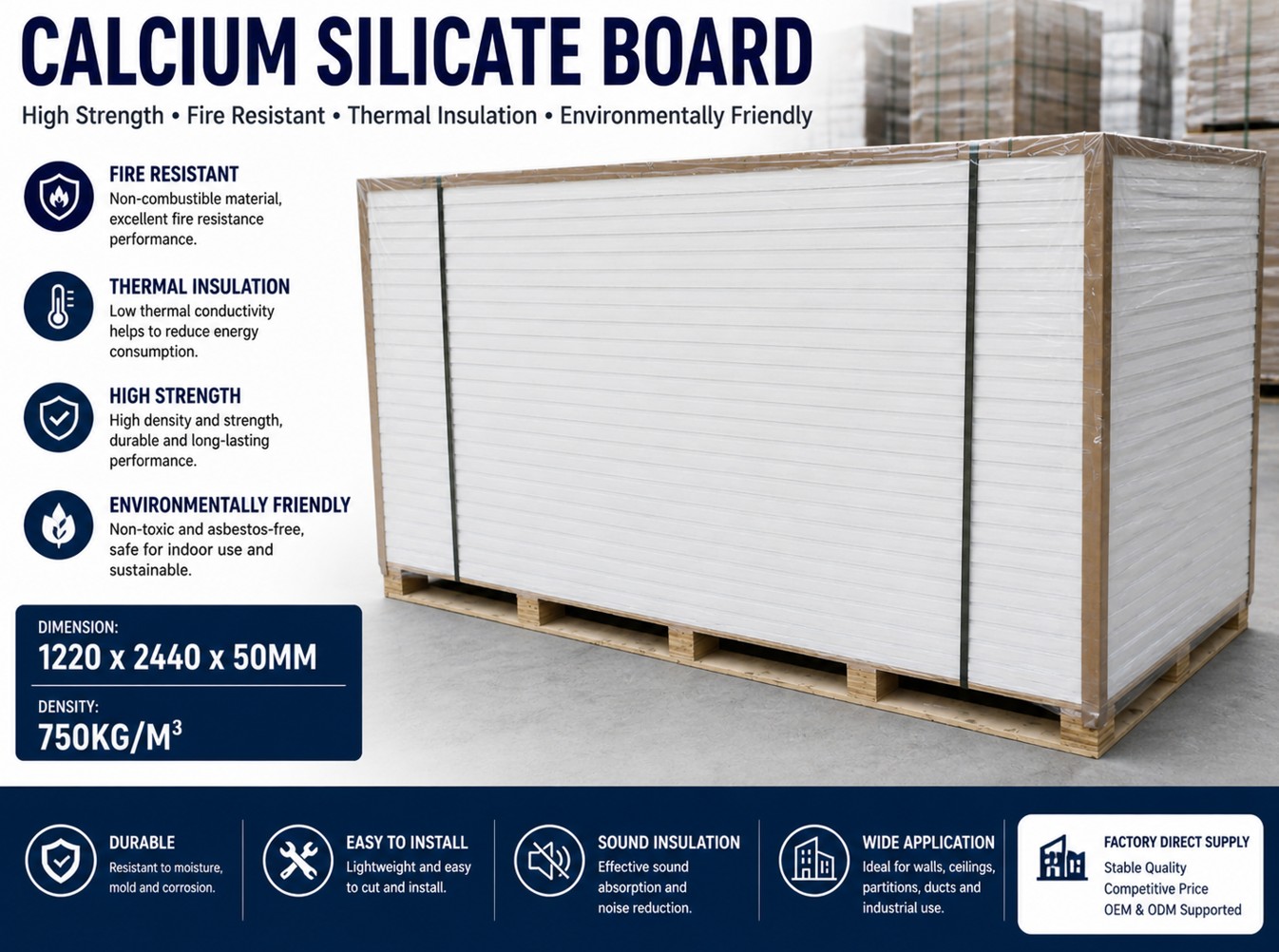
Boards are film-wrapped, edge-protected and loaded on pallets or in export crates for safe international shipping.
Why the Process Matters for the Finished Board
Two things set by manufacturing decide how the board performs in service:
- Autoclave conditions → temperature rating. Higher autoclave temperature favours xonotlite, which is why high-temperature grades can hold up near 1100°C (2012°F) while lower-temperature grades are limited to a lower service temperature.
- Pressing and water content → density and strength. The same raw materials can become a light 250 kg/m³ insulation board or a structural 650 kg/m³ board, depending on how the green board is pressed and dewatered.
This is also why density grades should be matched to the job rather than chosen by price alone. Low-density grades maximise insulation and energy saving; high-density grades add compressive strength and load-bearing capacity.
Low-Density vs High-Density Production
The biggest production difference between low- and high-density boards is the pressing and dewatering stage. High-density boards are pressed harder and carry less water into the autoclave, giving a tighter structure with higher compressive strength. They also tend to use a slightly different chemical balance. The forming and autoclaving principles, however, are the same across the range.
Frequently Asked Questions
Is calcium silicate board asbestos free?
Yes. It is manufactured from siliceous and calcareous raw materials with non-asbestos reinforcing fibres, and is classified A1 non-combustible.
How long does autoclaving take?
Autoclave curing typically runs for several hours under saturated steam at roughly 180–220°C (356–428°F). Exact time and temperature depend on the grade and board thickness.
What controls the density of the board?
Density is set mainly in the pressing and dewatering step. More pressing and less residual water produces a denser, stronger board; lighter boards retain more porosity for insulation.
What temperature can the finished board withstand?
It depends on the crystal phase formed during autoclaving. High-temperature xonotlite grades are rated up to about 1000–1100°C (1832–2012°F), while lower-temperature grades are rated lower. See the density guide for the rating of each grade.
Can boards be made to custom sizes and shapes?
Yes. After drying, boards are cut to size and can be CNC-machined into custom shapes such as pipe sections, rings and discs, with tight dimensional tolerances.
Do you supply factory-direct with export packaging?
Yes. We manufacture the boards and ship factory-direct, film-wrapped and palletised or crated for export. Contact us for a quote with your grade, size and quantity.


